System Design for Scale: Deconstructing the UPI Architecture
A deep dive into the 4-Party Model, NPCI Switch, and the asynchronous orchestration that powers 10 billion+ monthly transactions.

In the annals of fintech history, few innovations rival the scale, speed, and simplicity of India's Unified Payments Interface (UPI). Achieving over 10 billion transactions per month, UPI has not just democratized digital payments; it has rewritten the playbook on how national-scale financial infrastructure should be architected. As a Product Manager and Systems enthusiast, I've spent countless hours tracing the packets that fly between my phone, the NPCI switch, and the banking backend. What looks like a simple 'click-to-pay' is, in reality, a symphony of asynchronous microservices, distributed ledger updates, and cryptographic handshakes occurring in under 3 seconds. This article is my love letter to that architecture—a technical deconstruction of the engine running India's digital economy.
The 4-Party Model: Understanding the Players
Unlike a wallet system (like PayPal or Venmo's original implementation) where money is held in a staging area, UPI is a real-time inter-bank payment rail. It operates on a 4-Party Model, a term that simplifies the complexity of the routing logic. Let's break down the actors:
- 1Payer App (PSP)The interface layer (Google Pay, PhonePe, CRED). It doesn't hold money; it holds the 'address' (VPA).
- 2Remitter BankThe bank where the money actually lives. It holds the ledger and creates the debit entry.
- 3NPCI SwitchThe central router and arbiter. It resolves addresses and ensures the message format (ISO 8583 / JSON) is compliant.
- 4Beneficiary BankThe destination bank that credits the receiver's account.
- 5Payee App (PSP)The notification layer for the merchant or receiver.
The Switch: The Heart of Asynchrony
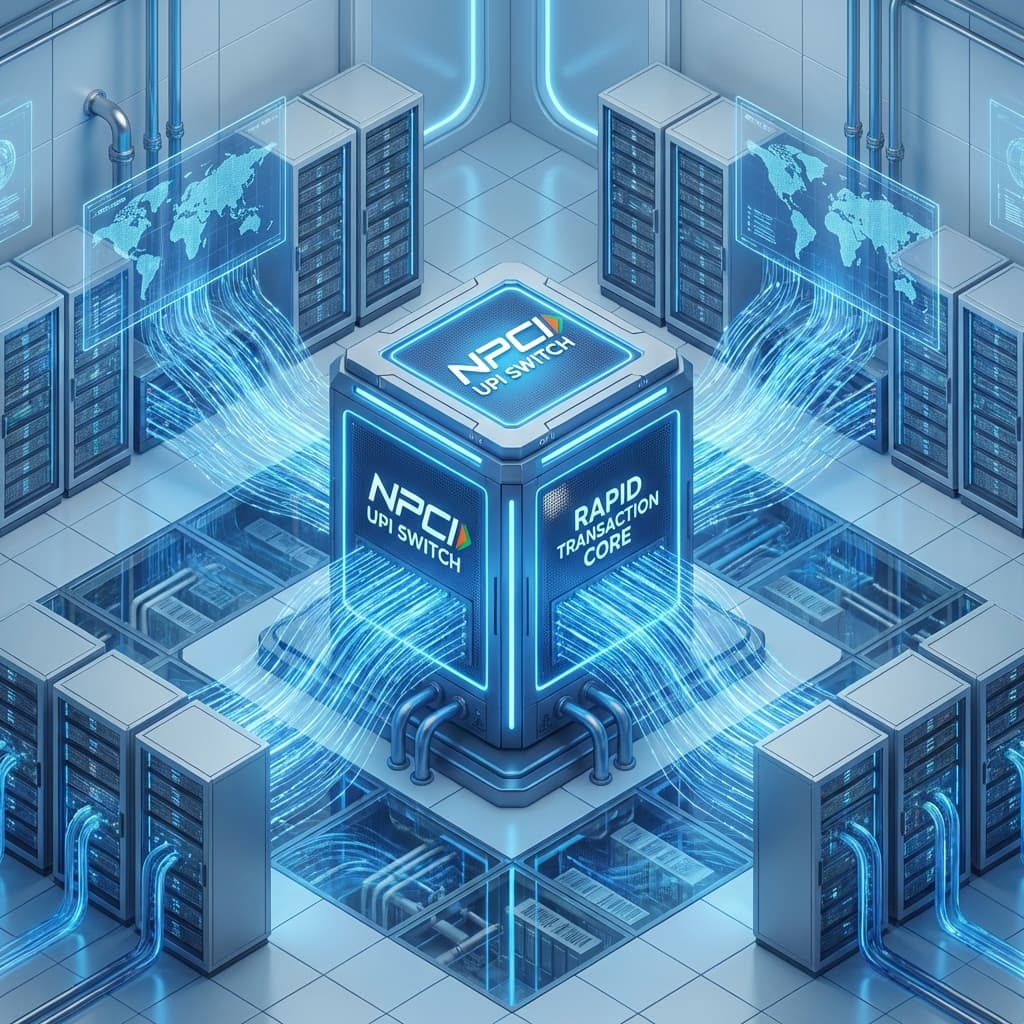
At the core of UPI lies the NPCI (National Payments Corporation of India) Switch. Imagine a traffic controller handling 3,000 requests per second, where each request requires confirmation from two independent, often legacy, banking systems. The switch is stateless in design but maintains transaction integrity through a rigid two-phase commit protocol. When you initiate a transaction, the switch doesn't just pass a message; it locks the state. If the Remitter Bank debits money but the Beneficiary Bank is down, the switch orchestrates the auto-reversal (UDIR - Unified Dispute and Issue Resolution). This resilience is why UPI success rates hover above 99% despite running on top of heterogeneous banking infrastructure that ranges from modern cloud stacks into 40-year-old COBOL mainframes.
Architecture of the 4-Party Model
Transaction Lifecycle: A Packet's Journey
Let's trace a standard P2P 'Push' transaction. You scan a QR code at a coffee shop. The QR code contains the merchant's VPA (e.g., merchant@hdfc) and a verified merchant name. 1. **Initiation**: Your app constructs a `ReqPay` API payload. This includes the payee VPA, amount, and a unique Transaction ID (TxnID). 2. **Address Resolution**: The request hits your PSP (Payment Service Provider). Your PSP doesn't know who 'merchant@hdfc' is. It forwards the packet to NPCI. 3. **Routing**: NPCI looks up the VPA registry. It identifies 'merchant@hdfc' belongs to HDFC Bank (the acquiring bank). 4. **Authorization**: NPCI routes the request to your bank (Issuing Bank). Your bank challenges you for the UPI PIN. This is the 2-Factor Authentication (2FA) - 'What you have' (Phone/Sim Binding) + 'What you know' (PIN). 5. **Debit**: Once the IPIN is validated, the ledger is updated. DEBIT User Account. 6. **Credit**: The confirmation travels back to NPCI, which then signals HDFC Bank to CREDIT Merchant Account. 7. **Finality**: Only when HDFC confirms the credit does NPCI send a 'Success' signal to both your phone and the merchant's speaker box.

Security: Encryption at Rest and in Motion
Security in UPI is fortress-like. The system employs PKI (Public Key Infrastructure) for trust. The `ReqPay` packet isn't just XML; it's a digitally signed XML document. Your app signs the payload with a private key residing in the secure element of your phone. Furthermore, the credential setup (setting your PIN) uses a library called the CL (Common Library) provided by NPCI. This library is embedded inside the PSP app (like Google Pay) but runs in a sandboxed environment. It captures the PIN and encrypts it using the bank's public key directly. Google Pay never sees your PIN; it only sees the encrypted blob. This 'pass-through' security model means even if the PSP is compromised, your banking credentials remain safe.

Scale: The Caching & Sharding Strategy
Taking a system to 10 billion transactions requires aggressive optimization. NPCI employs a Federated Architecture. The VPA mapping service is heavily cached at the edges to reduce latency during address resolution. High-volume banks (like SBI or HDFC) likely use dedicated, direct-connect pipes with NPCI, distinct from the commodity internet. Additionally, UPI Lite has introduced an 'On-Device Wallet' concept. For transactions under ₹500, the core banking system isn't pinged. The balance is maintained on the L1 (Device) and settled in batches effectively removing 80% of the load (small ticket transactions) from the heavy banking mainframes.
Visualizing the Invisible: The Transaction Flow
PROMPT used for generation:
Create a 60-second 3D animation showing a 'Data Packet' traveling through a futuristic city. The packet starts at a glowing smartphone, shoots up to a satellite (NPCI Cloud), splits into two beams (Authentication & Authorization), enters a massive digital bank vault (Remitter Bank), unlocks a chest (Debit), flies to another vault (Beneficiary Bank), deposits a coin (Credit), and returns as a Green Beam of Light to the user's phone. Style: Tron-meets-Minority Report. High contrast, neon colors, fast-paced.Sequence Diagram: The Exact API Calls
Why I Bet My Career on This Stack
Studying UPI isn't just about payments; it's about studying perfect distributed system design. It separates the 'Address' (VPA) from the 'Storage' (Bank Account), creating a loose coupling that allows innovation. You can switch banks but keep your VPA. You can switch apps but keep your history. This interoperability is the gold standard for open protocols. As we move towards CBDCs (Central Bank Digital Currencies) and cross-border UPI linkages (like the recent integration with Singapore's PayNow), the principles laid down by UPI—scalability, security, and simplicity—will define the next decade of global finance. And that is why, as a technologist, I am not just an observer of this revolution; I am an active participant, building the next layer of value on top of these rails.